
 support@niamonx.io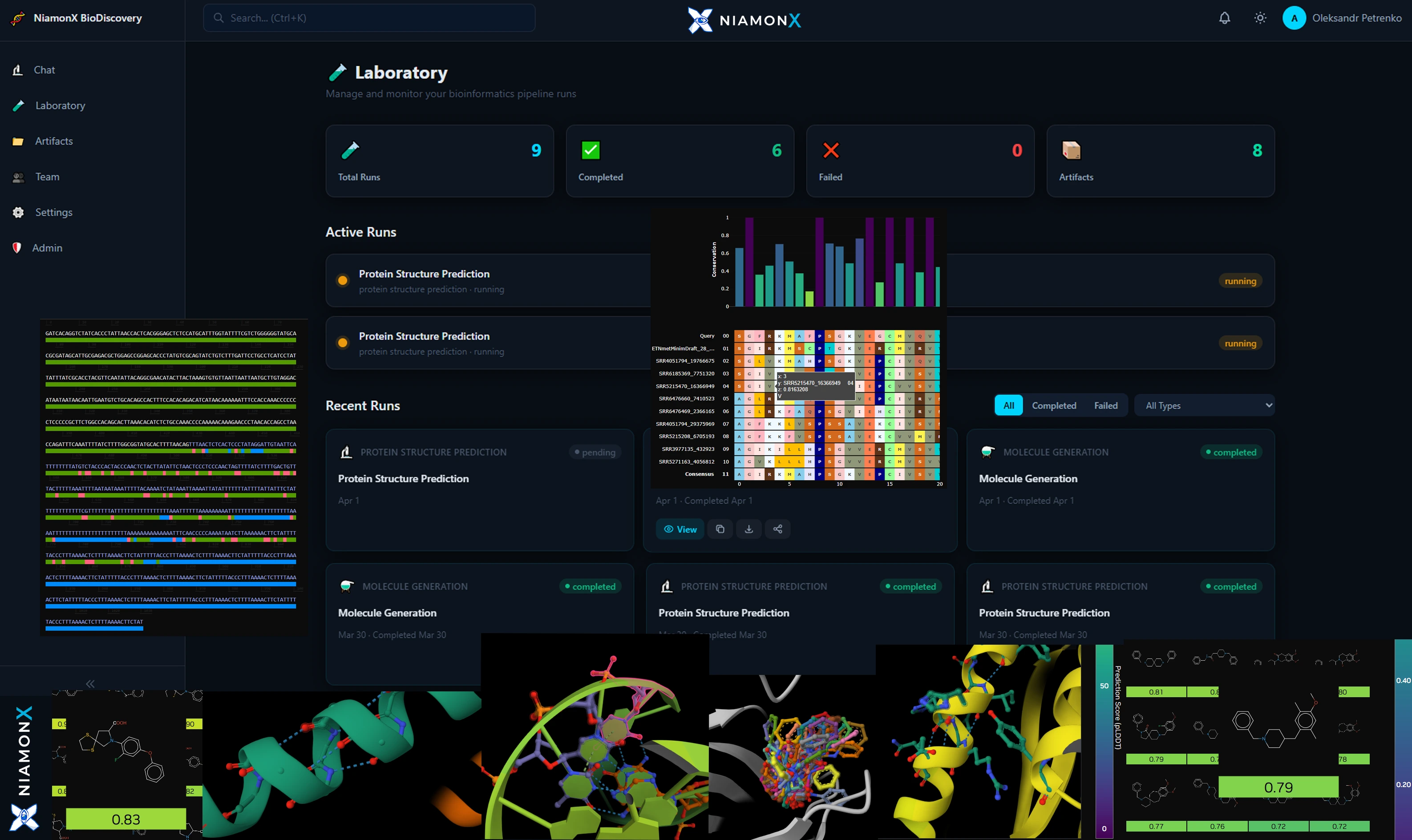
BioDiscovery Enterprise is an AI-native research platform by NiamonX LTD designed to help biotech, pharmaceutical, and computational biology teams move from scientific hypothesis to structured evidence faster. The platform connects AI-assisted prediction, scientific workflow automation, artifact management, lab validation planning, and reproducible decision-making in one secure enterprise workspace.
Instead of relying on fragmented scripts, disconnected bioinformatics tools, spreadsheets, and manual model execution, BioDiscovery transforms complex research goals into structured computational workflows. Researchers can describe a task in natural language, such as predicting a protein structure, analysing a mutation, generating molecule candidates, docking compounds against a target, or designing a binder, and the platform automatically builds an execution plan around that objective.
The core concept behind BioDiscovery is the Hypothesis-to-Evidence Engine: hypothesis → AI prediction → scientific artifacts → lab validation plan → evidence score → decision. This allows research teams to understand not only what an AI model predicted, but why a candidate was prioritised, which data supports it, what validation is required, and whether the result should move forward, be optimised, retested, or rejected.
Built for secure and scalable research environments, BioDiscovery combines computational biology workflows, multi-model AI orchestration, provenance tracking, audit trails, and future-ready integration with LIMS, ELN, laboratory data exports, and equipment-aware workflows. The platform is designed to support early-stage discovery, translational research, precision medicine research, genomics-driven investigation, and AI-assisted scientific decision support.
Core Features & Capabilities

01
Hypothesis-to-Evidence Engine
Convert scientific ideas into structured validation workflows. BioDiscovery links each hypothesis to predictions, model outputs, artifacts, validation plans, experimental evidence, confidence indicators, and final research decisions.

02
AI Workflow Automation
Transform natural language research requests into reproducible scientific pipelines for protein structure prediction, docking, molecule generation, genomics analysis, mutation impact evaluation, and binder design.

03
Multi-Model Intelligence Layer
Orchestrate advanced AI and computational biology models for structure prediction, molecular design, affinity estimation, DNA analysis, scientific narration, and candidate ranking through a unified execution layer.
04
Scientific Artifact Vault
Store and organise FASTA, PDB, mmCIF, SMILES, SDF, MOL2, MSA, JSON, CSV, and XLSX files with metadata, checksum validation, versioning, access control, and full provenance.
05
Lab Validation Planning
Move beyond prediction by generating suggested validation steps, assay planning logic, success criteria, expected outputs, and structured experimental result capture for downstream review.
06
Evidence Graph & Decision Support
Connect hypotheses, AI predictions, docking results, structure files, lab outcomes, confidence metrics, and final decisions into a searchable evidence graph for transparent scientific reasoning.
What You Can Achieve
Accelerate Early-Stage Discovery
Shorten research cycles by automating computational workflows, prioritising stronger candidates earlier, and reducing time spent on manual tool selection, data preparation, and result interpretation.
Validate Scientific Hypotheses Faster
Move from idea to evidence with structured workflows that combine AI prediction, artifact generation, confidence scoring, validation planning, and research decision tracking.
Reduce Fragmented Research Operations
Bring hypotheses, computational models, scientific files, lab results, team discussions, and final decisions into one governed workspace instead of scattered tools and disconnected spreadsheets.
Improve Reproducibility & Trust
Preserve model versions, input files, execution parameters, workflow history, artifacts, and decision context so that results can be reviewed, reproduced, audited, and shared with confidence.
How BioDiscovery Works
BioDiscovery is designed around a closed-loop research process. A scientist starts with a biological question or candidate idea, and the platform turns it into a structured workflow that can be executed, monitored, interpreted, validated, and documented.
01
Describe
Enter a scientific goal using natural language or upload biological data such as sequences, structures, molecules, assay results, or research files.
02
Plan
The platform classifies the intent, extracts scientific entities, identifies missing inputs, and builds a multi-step workflow with clear dependencies.
03
Execute
BioDiscovery routes each task to the appropriate AI or computational biology model and runs long-running jobs asynchronously in the background.
04
Analyze
Results are transformed into structured research outputs, visual cards, confidence metrics, scientific explanations, and downloadable artifacts.
05
Validate
The platform helps define validation steps, capture lab evidence, compare AI predictions with experimental outcomes, and update the evidence chain.
06
Decide
Research teams can advance, optimise, retest, or deprioritise candidates based on transparent evidence, confidence, risk, and reproducibility.
Enterprise-Ready AI Research Infrastructure
BioDiscovery is built for secure, scalable, and collaborative research environments. It combines enterprise architecture with scientific workflow intelligence, helping organisations manage complex AI-assisted research without losing control of data, provenance, or compliance requirements.
- Multi-tenant architecture with strict data isolation
- Role-based access control for teams, projects, artifacts, and research runs
- Immutable audit logs for traceability and governance
- Artifact storage with versioning, metadata, lineage, and checksum validation
- Asynchronous workflow execution for long-running computational biology tasks
- Real-time workflow monitoring and status updates
- Searchable research history across hypotheses, artifacts, conversations, and results
- Evidence graph for connecting predictions, validation results, and decisions
- Exportable research reports and reproducibility packages
- Integration-ready architecture for LIMS, ELN, lab data exports, APIs, and future equipment connectors
Designed for Future Lab Integration
BioDiscovery is not limited to AI prediction. The platform is designed to evolve into an instrument-aware research environment where computational predictions and experimental validation data can be connected within the same evidence workflow.
- Manual upload of assay results, CSV, XLSX, JSON, and instrument exports
- Structured parsing of experimental validation data
- Connection of lab results to the original hypothesis and AI prediction
- Future support for LIMS and ELN integrations
- Future connector layer for laboratory systems and equipment-aware workflows
- Roadmap compatibility with standards such as SiLA 2 and OPC UA where applicable
FAQ about BioDiscovery
AI-driven workflows, computational biology, hypothesis validation, and enterprise research infrastructure.
BioDiscovery Enterprise is used to support AI-assisted computational biology and early-stage discovery workflows, including protein structure prediction, molecular docking, molecule generation, genomics analysis, mutation impact research, binder design, artifact management, and hypothesis validation.
BioDiscovery is not just a conversational interface. It converts scientific goals into structured workflows, selects appropriate models, runs asynchronous jobs, stores artifacts, tracks provenance, explains results, and links predictions to validation evidence and research decisions.
No. Researchers can start with natural language or uploaded biological data. The platform is designed to reduce the need for manual scripting, DevOps setup, GPU management, and direct model orchestration.
Yes. BioDiscovery records the workflow plan, input files, parameters, model versions, generated artifacts, execution history, and decision context, helping teams reproduce and audit scientific results.
The platform is designed to support lab validation workflows. Initial capabilities can include structured uploads such as CSV, XLSX, JSON, and instrument exports, with a roadmap for LIMS, ELN, and equipment-aware integrations.
No. BioDiscovery is designed as a research and decision-support platform for computational biology, early-stage discovery, and scientific workflow automation. It is not positioned as a standalone clinical diagnostic or treatment decision system.
Yes. BioDiscovery is designed with enterprise requirements in mind, including multi-tenancy, RBAC, audit logging, secure artifact management, API integration, workflow monitoring, and scalable deployment options.