
 support@niamonx.io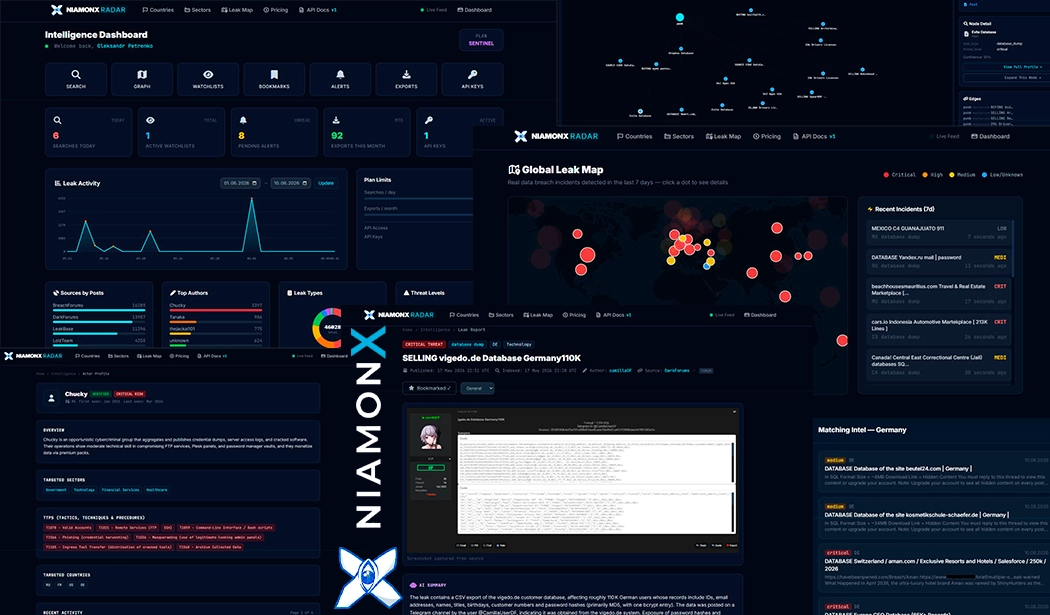
NiamonX Radar is an AI-powered threat intelligence and OSINT platform built for real-time cyber investigations, dark web monitoring, data leak intelligence, and enterprise security operations. Instead of forcing analysts to work across fragmented feeds, underground sources, screenshots, dashboards, spreadsheets, and manual notes, Radar transforms raw cyber threat data into a unified intelligence workspace where incidents, actors, IOCs, countries, sectors, watchlists, alerts, and investigation links can be searched, monitored, analyzed, and acted on.
The platform helps security teams monitor external cyber threat activity, including data leak records, ransomware-related publications, underground forum posts, credential exposure, database dump announcements, Telegram-based threat activity, actor activity, and public OSINT signals. Each intelligence record is structured with context such as threat level, leak type, affected country, industry sector, author, source, tags, publication time, indexed time, confidence, AI classification, and related investigation paths.
Designed for SOC teams, cyber threat intelligence analysts, incident responders, OSINT researchers, digital forensics specialists, MSSPs, security consultants, and enterprises, NiamonX Radar helps organizations detect external exposure earlier, track threat actors, pivot from IOCs, investigate leak records, monitor high-value watchlists, generate AI-assisted intelligence reports, and integrate actionable threat intelligence into real-world security workflows.
Core Features & Capabilities

01
Real-Time Threat Intelligence Feed
Monitor live cyber threat intelligence records with structured severity, country, sector, leak type, author, source, and timeline context. Radar helps analysts quickly identify critical and high-risk incidents, reduce noise, and prioritize external threats before they escalate into real business impact.

02
Dark Web Monitoring & Leak Intelligence
Track data leaks, credential exposure, database dumps, ransomware-related publications, underground forum activity, Telegram-based threat signals, and public OSINT records. Radar converts messy external threat data into normalized intelligence records with AI summaries, classifications, evidence, and investigation context.

03
Actor Intelligence, IOC Pivoting & Graph Investigation
Profile threat actors, review historical activity, analyze targeted countries and sectors, pivot from domains, IPs, hashes, wallets, emails, usernames, sources, and keywords, then visualize relationships between actors, posts, leaks, IOCs, organizations, countries, sectors, and intelligence records through graph-based investigations.
What You Can Achieve
Detect External Exposure Earlier
Identify leaked data, exposed credentials, dark web mentions, threat actor posts, ransomware-related signals, and suspicious cyber activity before they become larger incidents. Early awareness gives SOC and incident response teams more time to investigate, contain, notify, and reduce risk.
Connect Fragmented Threat Data
Turn isolated records into connected intelligence. Radar links threat actors, leak reports, IOCs, countries, sectors, sources, authors, tags, and related posts so analysts can understand whether an event is isolated or part of a wider campaign, infrastructure cluster, or repeated actor pattern.
Accelerate SOC Triage & Reporting
Reduce manual review time with AI-assisted summaries, threat classification, watchlist matching, graph investigations, intelligence reports, exports, and API integrations. Radar helps teams move from raw signals to actionable intelligence, executive-ready context, and repeatable security workflows.
How NiamonX Radar Works
Start with a cyber threat signal, a company name, a country, a sector, a threat actor, an IOC, or a keyword. Radar monitors external sources, normalizes raw records, enriches them with AI-assisted context, and helps analysts investigate relationships, monitor watchlists, generate reports, and integrate results into security operations.
01
Monitor
Radar continuously tracks external cyber threat activity, data leak records, underground sources, ransomware-related signals, actor activity, credentials exposure, and OSINT intelligence relevant to countries, sectors, organizations, and IOCs.
02
Analyze
The platform structures each record with severity, leak type, country, sector, source, author, tags, confidence, publication timeline, AI classification, summaries, and related investigation paths.
03
Investigate
Search across intelligence records, open detailed leak reports, review actor profiles, pivot from IOCs, expand graph relationships, monitor watchlists, trigger alerts, export results, and generate intelligence reports for action.
Enterprise-Ready Threat Intelligence Infrastructure
NiamonX Radar is built for modern security teams that need external cyber intelligence to be searchable, structured, connected, and operational. The platform supports real-time monitoring, watchlists, alerts, AI-generated reports, graph investigations, exports, API access, and analyst workflows designed for SOC, CTI, incident response, OSINT, digital forensics, and enterprise risk teams.
- Real-time threat intelligence feed for SOC and CTI teams
- Dark web monitoring, data leak monitoring, and credential exposure tracking
- Threat actor profiles with activity history, targeted sectors, targeted countries, and TTP context
- IOC pivoting for domains, IP addresses, hashes, wallets, emails, usernames, sources, and keywords
- Graph investigations for visual relationship mapping between actors, leaks, posts, IOCs, countries, sectors, and organizations
- AI-assisted summaries, threat classification, confidence scoring, and intelligence report generation
- Country intelligence, sector intelligence, global leak map, watchlists, alerts, exports, and API integrations
Unified Intelligence for NiamonX Ecosystem
Radar is designed to work as a threat intelligence layer inside the broader NiamonX ecosystem. It complements NiamonX Graph for relationship-based investigations, NiamonX Internet Surface for external infrastructure visibility, and other NiamonX security tools for OSINT, breach intelligence, exposure monitoring, and enterprise cyber risk analysis.
FAQ about NiamonX Radar
Threat intelligence, OSINT investigations, dark web monitoring, data leak intelligence, actor tracking, IOC pivoting, graph investigations, alerts, reports, and enterprise security operations.
NiamonX Radar is used for AI-powered threat intelligence, OSINT investigations, dark web monitoring, data leak monitoring, threat actor tracking, IOC pivoting, graph investigations, watchlist monitoring, alerts, cyber risk analysis, and enterprise security operations.
Radar is built for SOC teams, cyber threat intelligence analysts, incident responders, OSINT researchers, digital forensics specialists, MSSPs, security consultants, enterprise security teams, risk departments, and organizations that need structured external cyber intelligence.
Radar helps monitor external cyber threat activity, including data leak records, dark web sources, underground forum activity, ransomware-related publications, Telegram-based threat signals, credential exposure, database dump announcements, actor activity, and public OSINT intelligence.
Yes. Radar includes actor intelligence features that help analysts review threat actor profiles, verification status, risk level, first seen and last seen dates, targeted countries, targeted sectors, TTPs, aliases, recent activity, related leaks, posts, IOCs, and investigation links.
IOC pivoting allows analysts to start from an indicator such as a domain, IP address, hash, wallet, email, username, source URL, author handle, organization name, or keyword and discover related actors, leak records, campaigns, infrastructure, countries, sectors, and intelligence objects.
Graph Investigation visualizes relationships between threat actors, IOCs, leak records, posts, sources, organizations, countries, sectors, and related intelligence. This helps analysts move from isolated records to connected intelligence and discover hidden links faster than traditional list-based workflows.
Yes. Radar uses AI-assisted analysis to summarize intelligence records, classify threat levels and leak types, identify affected sectors and countries, support MITRE ATT&CK-style context, generate confidence scores, and produce structured intelligence reports for analysts and security teams.
Yes. Radar is designed with API access, exports, watchlists, alerts, reports, and structured intelligence workflows so enterprise teams can integrate threat intelligence into dashboards, SIEM/SOAR processes, ticketing systems, enrichment pipelines, SOC workflows, and incident response operations.